
Salawat FAQ
Salawat FAQ: Find clear answers to common questions about sending blessings upon Prophet Muhammad ﷺ, including meaning, authentic wording, daily targets, rewards, Friday, salah, wudu, menstruation, children, and practical habit-building.
About This Salawat FAQ
This Salawat FAQ is designed for beginners, families, students, reverts, and anyone who wants dependable, easy-to-understand guidance about sending blessings upon Prophet Muhammad ﷺ.
The answers explain both everyday practice and important distinctions between authentically transmitted forms of salawat and later devotional wordings.
For deeper study, follow the related links provided throughout the page and use the Continue Learning section at the bottom.
Basic Salawat FAQ Questions
What is salawat?
Salawat means asking Allah to send blessings, honour, and peace upon Prophet Muhammad ﷺ. It is an act of worship, love, respect, remembrance, and obedience to Allah.
What does the word salawat mean?
In this context, salawat refers to supplicating to Allah to bless, honour, and elevate Prophet Muhammad ﷺ.
Why do Muslims send salawat?
Muslims send salawat because Allah commands believers to do so in the Qur'an and because it expresses love, gratitude, honour, and respect for His Messenger ﷺ.
Is salawat mentioned in the Qur'an?
Yes. Surah Al-Ahzab 33:56 states that Allah and His angels send blessings upon the Prophet ﷺ and commands believers to send blessings and peace upon him.
What is the difference between salawat and salam?
Salawat refers to blessings and honour upon Prophet Muhammad ﷺ, while salam means sending peace upon him. Many established phrases include both.
Is sending salawat an act of worship?
Yes. It is an act of remembrance and obedience performed for Allah while honouring Prophet Muhammad ﷺ.
Salawat FAQ: How to Recite Salawat
How do I send salawat?
You may use a short wording such as “Allāhumma ṣalli ʿalā Sayyidinā Muḥammad” or learn the complete Salat Ibrahimiyyah transmitted in authentic hadith.
Which salawat wording is best to learn first?
Salat Ibrahimiyyah is one of the most firmly established forms because Prophet Muhammad ﷺ taught it to his companions and Muslims recite it during salah.
Can beginners use a short salawat?
Yes. A short wording is suitable for beginners, children, busy Muslims, and anyone developing a new daily habit.
Must salawat always be recited in Arabic?
Learning an Arabic wording is strongly recommended because the transmitted forms are in Arabic. Beginners may also study the meaning in their own language to improve understanding.
Can I say the meaning in English?
You may make duʿāʾ in English and reflect on the meaning. However, learning at least one established Arabic wording is valuable and practical.
Should I understand what I am reciting?
Yes. Understanding the meaning helps salawat become a conscious supplication rather than mechanical repetition.
A Short Salawat for Beginners
A simple wording suitable for daily remembrance is:
Transliteration: Allāhumma ṣalli ʿalā Sayyidinā Muḥammad.
Meaning: O Allah, send blessings upon our master Muhammad ﷺ.
Read the Short Salawat GuideSalawat FAQ About Rewards and Virtues
What is the reward for sending one salawat?
An authentic hadith states that whoever sends one blessing upon Prophet Muhammad ﷺ receives ten blessings from Allah.
Does salawat bring mercy and blessings?
Yes. Authentic narrations establish great general virtues for sending blessings upon Prophet Muhammad ﷺ.
Does Prophet Muhammad ﷺ receive our salam?
Authentic narrations mention that angels convey the salam of members of the Ummah to Prophet Muhammad ﷺ.
Why is Friday important for salawat?
Muslims are encouraged in authentic narrations to increase salawat upon Prophet Muhammad ﷺ on Friday.
Does salawat soften the heart?
Regular salawat may support remembrance, gratitude, love, reflection, and emotional connection to the life and guidance of Prophet Muhammad ﷺ.
Does every fixed number have a special reward?
No. Some daily numbers are used only as practical personal goals. A specific religious reward for a particular number requires reliable evidence.
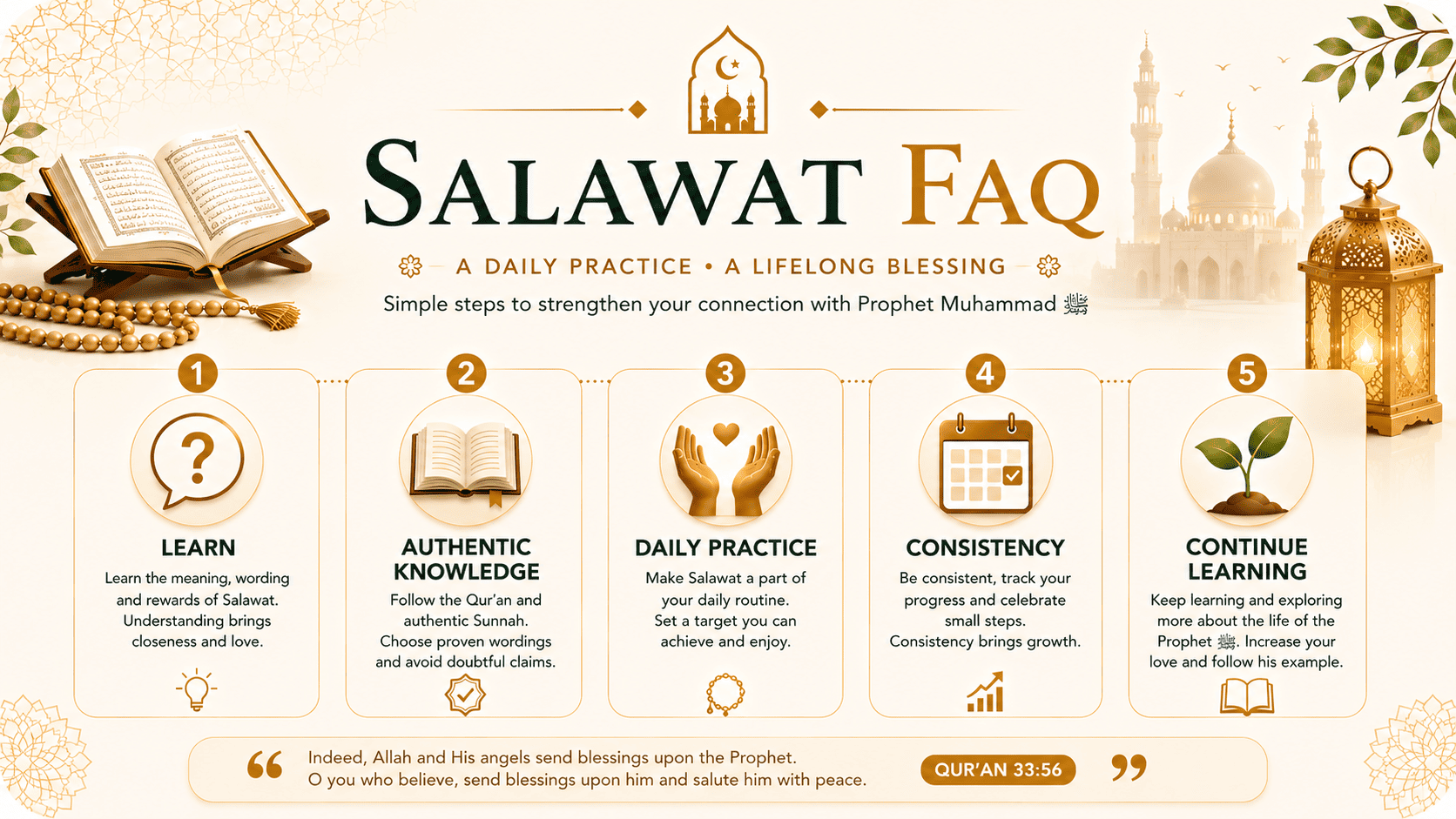
Salawat FAQ About Daily Practice
How many salawat should I recite every day?
There is no single compulsory daily number. Many people begin with 10, 33, 50, or 100 according to their ability and then increase gradually.
Is 100 salawat a good daily goal?
Yes. For many people, 100 is a realistic target that helps build consistency without becoming overwhelming.
Can I recite salawat while working?
Yes, provided it does not interfere with your responsibilities, concentration, or safety.
Can I recite salawat while driving?
Yes. Quiet remembrance is permissible so long as your full attention remains on safe driving.
Can I recite salawat before sleeping?
Yes. Before sleep is a peaceful time for salawat, dhikr, gratitude, and duʿāʾ.
Can I make salawat throughout the entire day?
Yes. Salawat can be recited throughout the day whenever appropriate, making it one of the easiest acts of remembrance to maintain.
Salawat FAQ About Salah
What is Salat Ibrahimiyyah?
Salat Ibrahimiyyah is the well-known salawat recited during the final tashahhud in salah. It is among the most authentic forms taught by Prophet Muhammad ﷺ.
Should every Muslim learn Salat Ibrahimiyyah?
Yes. Because it is recited during the daily prayers, every Muslim should try to memorise both its Arabic wording and its meaning.
May I use a short salawat outside salah?
Yes. Outside salah you may recite short or longer established forms of salawat throughout the day.
Can I recite different authentic wordings?
Yes. Authentic narrations include more than one wording, and learning different authentic forms is beneficial.
Should I understand the meaning while praying?
Understanding the meaning increases concentration, humility, and appreciation during worship.
Salawat FAQ About Wudu and Daily Situations
Can I recite salawat without wudu?
Yes. Salawat is a form of dhikr and may be recited without wudu. Having wudu remains a virtuous state whenever possible.
Can women recite salawat during menstruation?
Yes. Salawat is remembrance of Allah and may be recited during menstruation.
Can I recite salawat while lying down?
Yes. Salawat may be recited while standing, sitting, walking, travelling, or lying down.
Can children learn salawat?
Absolutely. Teaching children a short salawat is a beautiful way to nurture love for Prophet Muhammad ﷺ from an early age.
Can elderly people use short salawat?
Yes. Short forms are ideal for elderly Muslims and anyone who finds long texts difficult to memorise.
Salawat FAQ About Authenticity
Which salawat is the most authentic?
Salat Ibrahimiyyah is among the strongest established forms because it is authentically narrated and recited in salah.
Are all popular salawat wordings authentic hadith?
No. Some are devotional compositions written by respected scholars. They should not automatically be described as authentic prophetic narrations.
Should I verify special reward claims?
Yes. Claims about guaranteed outcomes, fixed numbers, or extraordinary rewards should always be checked against reliable Islamic evidence.
Can I recite traditional salawat written by scholars?
Yes, provided their meanings are sound. However, specific religious merits should not be claimed without authentic evidence.
Should fabricated narrations be avoided?
Yes. Muslims should avoid sharing fabricated hadith or unsupported reward claims regarding salawat.
Simple Salawat FAQ Habit Plan
Recite 10–25 salawat after Fajr before beginning your daily activities.
Use waiting time, travel, walking, or quiet moments for additional salawat.
Complete your chosen daily target after Maghrib or before sleeping.
Increase your salawat throughout Jumu'ah and encourage family members to join you.
Build Your Daily Salawat Habit
Start with a realistic goal, remain consistent, and allow your love for Prophet Muhammad ﷺ to grow through daily remembrance.
Start the 100 Salawat ChallengeRelated Salawat Resources
How to Send Salawat
Learn the correct way to send blessings upon Prophet Muhammad ﷺ with Arabic text, transliteration, meanings, and practical guidance.
Read the Guide →Authentic Hadith on Salawat
Explore authentic narrations about the virtues and rewards of sending blessings upon Prophet Muhammad ﷺ.
Read Authentic Hadith →Benefits of Daily Salawat
Discover the spiritual benefits of making salawat part of your daily remembrance.
Explore the Benefits →Best Times to Recite Salawat
Learn the recommended occasions for increasing salawat throughout the day and especially on Friday.
Read More →Daily Salawat Routine
Follow a practical routine using printable trackers and realistic daily goals.
Build Your Routine →Salawat Library
Browse the complete Halalings collection of salawat, Arabic texts, explanations, and printable resources.
Visit the Library →Further Reading
❤️ Support Halalings
If this Salawat FAQ has benefited you, consider supporting Halalings. Your contribution helps us continue creating free Islamic articles, printable guides, children's resources, and authentic educational content for Muslims around the world, in shā' Allāh.
Unable to donate? Sharing this Salawat FAQ with family and friends and making duʿāʾ for Halalings are also valuable ways to support this project. May Allah reward you abundantly. Āmīn.
📚 Continue Learning
Salawat Library • How to Send Salawat • Qur'an Verses About Salawat • Authentic Hadith • Benefits of Daily Salawat • Best Times to Recite Salawat • Common Mistakes • Types of Salawat • Short Daily Salawat • Salat Ibrahimiyyah • Salat al-Fatih • Salat al-Munjiyah • Salat al-Nariyah • Salat al-Tibbiyyah • Salat Tunjina • Daily Salawat Routine • 100 Salawat Challenge • 300 Salawat Challenge • 1000 Salawat Challenge • Salawat Club